

AI can (and will) create transformative impact.
Boards and investors are pressuring teams to realize productivity gains.
So why are so many PE-backed CEOs and CFOs struggling to find “it”?
Definitions matter: a journey back to Econ 101
Companies simply exist to create shareholder value, and doing so involves many different levers across operations, growth, capital, financing and strategy. That said, those levers ALL come back to one simple term — productivity.
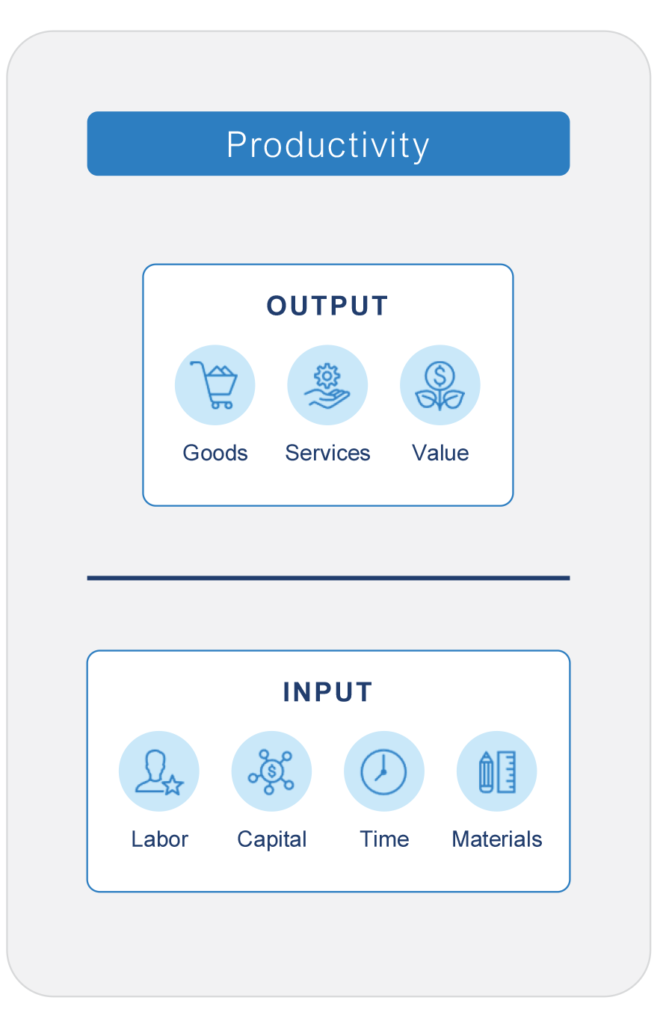
Productivity is defined as the ratio of output to input. There are two ways to increase it:
- Increased output with the same or lesser input
- Decrease input while yielding the same or greater output
Of course this isn’t new — you likely learned it in school (even if it was from the back row, half-awake). But this core principle is foundational for understanding why something that is so simple has become incredibly complex to realize in the real world of running a business.
Said differently, if we all suddenly have a set of tools that are — without question — creating incredible step changes in both inputs and outputs, then why are many executives struggling to put their hands on the true financial productivity?
There are one million (and counting) thought pieces about how too many companies are wielding AI looking for business problems like a hammer looking for a nail. For clarity, I completely agree with that issue, and it is something we observe every day with clients. That said, in my opinion, it’s a point-in-time issue as the education and adoption curve grows and frankly is much less interesting than what’s going on under the covers of trying to run a business.
Against that backdrop, we’re seeing three much more nuanced (but material) challenges:
- Translating AI speed into productivity
- Rationalizing the difference between roles and tasks
- Balancing front-line innovation with telemetry / management of AI costs
Conflating “speed” with “productivity”
Every minute of the day executives are exposed to another terrifying (and yet inspiring) example or headline of how much speed AI can create for their organization. These range from exciting growth opportunities (new product or service features) to step changes in automation of human-driven tasks (marketing content, finance processes, coding, etc.).
All of these are real; I’ve seen them first-hand in our work with clients. The ability for AI initiatives to transform time-consuming tasks or processes is mind-blowing, constantly creating a “what a time to be alive” experience. AI is making every business — regardless of industry — a tech business, which is an incredibly exciting prospect.
But the most immediate and tangible result of many AI initiatives is speed. That’s not a bad thing . . . but it’s not necessarily productivity.
Let’s use a simple example: a car. We all know speed in a car can create a thrilling sensation of what’s not normally possible. But just because you can suddenly drive a car much faster, it’s not “productive” unless (a) it’s driving in the right direction, (b) you can utilize the speed within the regulations, (c) you can re-deploy the time saved into creating more output (i.e., does the extra time allow you to sell another widget?), and the most nuanced one (d) the value of the time saved (lower input) is not offset by the cost of the extra fuel burned (higher input).
Yes, all of that is complex — and that’s exactly the point! Converting speed into productivity is not about the speed; it’s about what you do with the capacity it creates.
As an example, a vertical SaaS platform that is using AI to dramatically accelerate its product development lifecycle created meaningful capacity. In this case, management made a very conscious decision to redeploy the capacity — in a measurable way — towards developing a product for a completely new market, bringing in revenue not previously available to them. In the car analogy, the company didn’t just accelerate; they drove further.
If speed alone immediately allows you to sell more goods or services, then you have it easy. That’s the simplest conversion creating more output (growth) for same or lesser input (total investment).
But that’s not what most executives are facing. They’re facing an equation that looks like this:
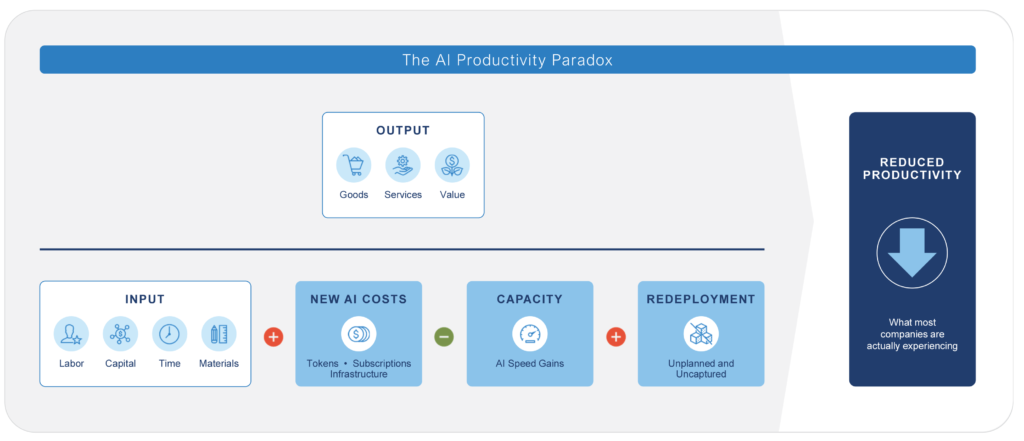
For most, you’ve had successful AI initiatives and are starting to “re-wire” old processes. But you’re facing the challenge of not having fewer resources (more on this below) and in parallel, a huge new line item of AI-associated costs. And if you don’t lean into the latter, you’re a dinosaur, but you’re quickly realizing (a) you don’t have the proper telemetry to manage the cost and (b) you can’t find the result of the AI costs that allow you to offset others.
Sound familiar? If so, you’re not alone. This brings us to the second challenge.
The important difference between “tasks” and “roles”
While a less inspiring topic than transformative growth, many of the immediate productivity gains through AI are envisioned to be cost-oriented — i.e., fewer inputs or in some cases, labor. We’ve seen three approaches:
- Slash: Those who just slashed jobs under the banner of AI even before it was really technically advanced enough to drive true productivity — as Jensen Huang somewhat recently pointed out here.
- Reallocate: Mostly isolated to the hyperscalers (understandably), this approach involves aggressively cutting labor in order to free up the funds necessary for AI-related infrastructure and investment. It’s not productivity; it’s capital reallocation.
- Optimize: This is where most companies sit; taking an intentional but measured approach to rationalizing costs unlocked by AI.
When executives in the “Optimize” bucket struggle to realize productivity, they’re often seen (including by their Boards) as too slow or failing in the implementation of AI. While both can absolutely be true, in many cases they’re struggling with a more nuanced challenge — task productivity is not synonymous with labor productivity.
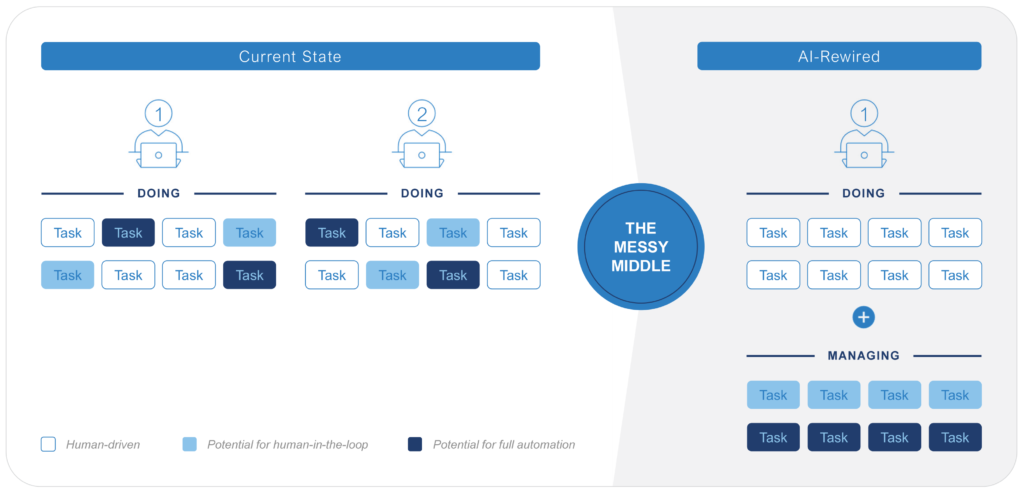
Framed simply, all of us in the white-collar economy execute what is simply a collection of tasks. Those tasks come together to form a role or job. And a collection of jobs forms a functional group or department — often with overlapping but rarely totally redundant roles.
In the best AI deployments, companies are creating opportunity (for productivity) through the automation or acceleration of tasks and processes. In turn, these are freeing up time to either (a) redeploy that time to a higher value activity or (b) reduce input costs.
Redeployment of time is the right, noble and well-intentioned pursuit, but it’s also a matter unique to each company. I will avoid pontificating on this theme, but the clear result — if it is to truly create productivity — MUST be to create more output for the same input (given you redeployed the time). If this is not clear, you probably just accidentally “reinvested” . . . and probably with overall higher input costs given the expense of the AI-related efforts.
But for many others, they are driving parallel efforts to both advance AI and to more directly lower overall input costs. The challenge, however, is that automating “tasks” is not the same as automating “roles” or jobs. The latter requires:
- Automating enough tasks to be material for a given role
- Doing so across multiple roles / job types
- Re-imagining a new consolidated role
And that new role is also different — and requires different talent. It’s not just a series of manual tasks again. It’s three things:
- Remaining manual tasks from the two pre-existing jobs
- Human-in-the-loop judgment / approval tasks
- Agent management
The effect is that everyone in the reimagined org is execution, approval and manager — often not the case on Day 1.
Balancing the desire to stoke innovation with cost and control
Being a CFO or CTO is more difficult than ever. Of course, you want to support and celebrate the AI innovation that is now possible at the “front line,” as it can unlock incredible results that no corporate IT initiative could have achieved before.
But unless you have the proper controls and infrastructure in place, unchecked AI is like giving everyone in your company a corporate credit card and saying, “be responsible.”
Unfortunately, that actually understates the challenge. In the case of AI (unlike corporate travel), the user rarely knows what they’re spending in the moment. If you go to a restaurant, you see the cost of the bottle of wine before you order. In most organizations (today), if you build a new agent, the user has no idea as the formula is complex.
Now, in fairness, some of this will change as organizations — like ours — develop more robust telemetry solutions. But the solution providers — exactly like what happened in the adoption of cloud computing — will continue to advance their commercial models to make them more nuanced and complex to stay ahead.
As the token subsidies roll off, you’re seeing clear evidence of this from the hyperscalers, which are quickly removing “all you can eat” options in favor of much more complicated commercial packages.
The advanced AI deployments today are not only building the telemetry and permissions to manage the cost. They are also getting more mature in model selection for every single task driven by AI, determining when you can use lower-tier or open-source models vs. the Ferrari. This is a daily battle for even the most advanced organizations. Most companies are earlier in the journey, still trying to determine what they are spending, who is spending it and what value they are receiving — before the invoice arrives.
So, for Boards and CEOs — what to do?
None of the aforementioned is a reason to wait. AI is here, and it’s creating transformational change — so go all-in! But in doing so, ensure you engage deeply on the following questions:
- How are we converting speed to productivity — what is the actual “money step”?
- Where have we re-imagined specific roles (not just automated tasks)?
- Do we have the transparency and telemetry to manage the investment on a daily, monthly, yearly view?
The combination of these things is what will ultimately create productivity. The definition may be simple, but the pursuit is anything but.

About the author: CEO Barr Blanton has the privilege of leading Crosslake, a firm focused exclusively on technology and AI work for private equity firms and their portfolio companies. In the past five years, Crosslake has worked with more than 700 PE firms and thousands of portfolio companies to drive technology transformation. Like many of its clients, Crosslake is backed by private equity investment from Falfurrias Capital Partners and Leonard Green & Partners.
